Hi, my name is Jacob and this is my blog! :)
I've heard this a few times from people, seen it quoted a few times, but don't know where it originates: "I see dead things."
And while I know for a fact that this isn't from Song of Solomon, it very well could be. Death comes up numerous times throughout the novel, both actually and figuratively.
First off, the novel centers around Milkman, and his family...the Dead family. And besides the name, there's a lot of dead things circling around them. For one, their car for Sunday drives is known to the locals as the hearse, as it is treated delicately, never used for fun, and never goes over 20 mph. Not only does the car act like a hearse, it or its drivers, never "live a little" by taking risks or having fun with it. Heck, I drive a Prius and I'm able to have more fun than they do with their kick-ass, full gasoline, car. Just saying...
The Dead family is also pretty boring...we talked in class about the differences in the atmosphere between Milkman's and Pilate's homes. The Dead house is strict, and uptight, while Pilate's family is relatively easy-going and lax, listening to music and working together. Meanwhile, the Deads' relationships are strained, with family members lashing out at each other from time to time (Milkman to Macon, Macon to Ruth, ...) Needless to say, Pilate's family seems to be getting more out of, and having a better life, than the Deads.
And besides metaphorically dead families, there are dead people in the novel! Early on we hear the stories of Robert Smith, who failed trying to fly off a building, and see a drunk Henry Porter threatening to kill himself before passing out. Later on, we hear the story of how Macon Jr. killed the man in the cave, the discovery of the gold, and then goes on to try and find his grandfather's bones, which washed into a cave as well. Milkman's life is also threatened, and almost taken, by both Hagar and Guitar who threaten to kill him. Guitar also is part of the Seven Days, an organization which vows to avenge the unpunished murders of blacks by killing whites in the same manner on the same day
So yeah, death is a constant presence, and an important one at that, throughout Song of Solomon.
P.S. Death itself is an escape, or flight from life. And as we've talked about, flight is another important theme in the novel (Smith's failed flight, flying hood ornament, Milkman wanting to fly, Milkman taking the plane, Milkman flying away from the nest, etc.). But that could be the idea behind another blog post. I digress.
See you all later...thanks for reading!
Jacob
Tuesday, December 15, 2015

Friday, November 13, 2015
Not So Happily Ever After: Portrayals of Marriage in our Readings
In a lot of literature and our society, marriage is seen and viewed as a happy thing, a sign of love and togetherness that will last for a long while. But in many of the novels that we've read in class this year, the portrayals of marriage given are anything but positive. With the exceptions of The Mezzanine (on account of it being more focused on staplers) and The Metamorphosis (on account of its main character being a cockroach, and thus unable to marry), marriage plays important roles in the novels that we've read.
In Mrs. Dalloway, The Sun Also Rises, and The Wide Sargasso Sea, we see marriage happen not so much out of love but as a move for status or money. And in all these cases, we see rather unhappy endings or results. Rather than going off into the sunset, deep in love, we see Clarissa Dalloway ponder suicide as a good thing, by ending an unhappy life on one's own, and on their own terms. Brett fails to find true love, having already gone through two unhappy marriages for money and possibly going into a third with Mike Campbell, instead settling for quick flings and failed attempts at love, as seen with Romero. Antoinette is renamed Bertha Mason, goes crazy, and spends the rest of her days in the attic of her husband's England home, where he rarely resides.
In The Stranger, while marriage does not play as large of a role, we see Meursault treat the concept of marriage as fairly light and not so serious. While he is attracted to Marie, there is no real deep attachment, stating that either married or not, it makes no difference to him. This trivializes the concept of marriage, seen as an important and proper step in many societies, and undoubtedly in the society of Meursault.
Not only are these not just positive outlooks on marriage, they're actually nightmarish results of what can, and in these cases, did go extremely wrong with marriage. It's interesting to pick up on this trend throughout the novels we read. I'm not sure if it was done intentionally or not as part of the class curriculum, representative of general 20th century literature or not, but it's been a trend that I've picked up on recently, and has really fascinated me, and wondered if it might fascinate others as well.
Jacob
In Mrs. Dalloway, The Sun Also Rises, and The Wide Sargasso Sea, we see marriage happen not so much out of love but as a move for status or money. And in all these cases, we see rather unhappy endings or results. Rather than going off into the sunset, deep in love, we see Clarissa Dalloway ponder suicide as a good thing, by ending an unhappy life on one's own, and on their own terms. Brett fails to find true love, having already gone through two unhappy marriages for money and possibly going into a third with Mike Campbell, instead settling for quick flings and failed attempts at love, as seen with Romero. Antoinette is renamed Bertha Mason, goes crazy, and spends the rest of her days in the attic of her husband's England home, where he rarely resides.
In The Stranger, while marriage does not play as large of a role, we see Meursault treat the concept of marriage as fairly light and not so serious. While he is attracted to Marie, there is no real deep attachment, stating that either married or not, it makes no difference to him. This trivializes the concept of marriage, seen as an important and proper step in many societies, and undoubtedly in the society of Meursault.
Not only are these not just positive outlooks on marriage, they're actually nightmarish results of what can, and in these cases, did go extremely wrong with marriage. It's interesting to pick up on this trend throughout the novels we read. I'm not sure if it was done intentionally or not as part of the class curriculum, representative of general 20th century literature or not, but it's been a trend that I've picked up on recently, and has really fascinated me, and wondered if it might fascinate others as well.
Jacob
Monday, November 2, 2015
In the Name of Who?
"In fact, I had no time to look, as the presiding judge had already started pronouncing a rigmarole to the effect that 'in the name of the French people' I was to be decapitated in some public place."
In the name of the French people, Meursault is to be put to death, having murdered an Arab. But, it does not seem to be this murder which is at the heart of the reasoning behind his execution. It merely serves as a preciptating event which brings Meursault to trial, along with his rather detached, uncaring mindset, which is what is really scrutinized throughout the trial.
How can I say that a penalty of death for the murder of the Arab, and only for the murder, was done in the name of the French people? Because to the French court, the Arab (and his family) are neither seen as Frenchmen, treated like Frenchmen, or given the respect Frenchmen would be given in a French court of law. In fact, as one panel presentation pointed out, the Arab is never mentioned after Chapter 6. Not only does the court forget about the Arab as a minor component to the proceedings, but so does Meursault, and even Camus.
We never see anyone related to the Arab at the trial, nor do we ever hear their side of the story. Instead, the trial focuses on Meursault's actions following the death of his mother, which the prosecutor finds him "morally guilty of. Seen as "heartless" and as a "criminal devoid of the least spark of human feeling", Meursault is put to death for not being a part, to any extent, of the then-contemporary society. Meursault operates completely isolated from that, and is therefore not only a part of it, but a threat to its functioning. His lack of compassion towards his mother's death indicates a potential disregard for human life, indicating that Meursault could potentially be a threat to murdering others. And while this may be a case in the eyes of the court, I saw Meursault as just being indifferent towards the passing of his mother, rather than as becoming happy as a result.
The flaws of the court system are shown quite clearly, even beyond this focus on a completely separate event than the one leading to him being tried. Meursault is accused of premeditated murder, of someone he had never met (or even heard of!) prior to the violent encounters of that day, someone who he killed as an adverse and ill-advised reaction to the glinting sunlight of the beach, possibly also suffering from heat exhaustion or another condition leading to him not being present in a complete mental state. To accuse Meursault of premeditated murder doesn't seem to make any sense at all in my eyes, even if one hasn't seen the story from Meursault's perspective. While there are details which would obviously be obscured or completely hidden if they weren't observed from Meursault's perspective, premeditated murder seems to be a rather large leap, once again as an excuse to put Meursault to death, for his danger to society, seen through the death of his mother. His mother's death could be seen as a moral patricide, being tried before the case of an actual patricide, potentially influencing the way that the case is looked at.
Meursault is not put to death for the murder of the Arab, nor in the name of the French people who he supposedly endangers, but is put to death for being seen as emotionless, uncaring, and as an overall threat to the society in which he lives, showcasing major faults in a court system, and in the death penalty, given to a man who had no intention of killing anyone, or causing societal or widespread harm.
In the name of the French people, Meursault is to be put to death, having murdered an Arab. But, it does not seem to be this murder which is at the heart of the reasoning behind his execution. It merely serves as a preciptating event which brings Meursault to trial, along with his rather detached, uncaring mindset, which is what is really scrutinized throughout the trial.
How can I say that a penalty of death for the murder of the Arab, and only for the murder, was done in the name of the French people? Because to the French court, the Arab (and his family) are neither seen as Frenchmen, treated like Frenchmen, or given the respect Frenchmen would be given in a French court of law. In fact, as one panel presentation pointed out, the Arab is never mentioned after Chapter 6. Not only does the court forget about the Arab as a minor component to the proceedings, but so does Meursault, and even Camus.
We never see anyone related to the Arab at the trial, nor do we ever hear their side of the story. Instead, the trial focuses on Meursault's actions following the death of his mother, which the prosecutor finds him "morally guilty of. Seen as "heartless" and as a "criminal devoid of the least spark of human feeling", Meursault is put to death for not being a part, to any extent, of the then-contemporary society. Meursault operates completely isolated from that, and is therefore not only a part of it, but a threat to its functioning. His lack of compassion towards his mother's death indicates a potential disregard for human life, indicating that Meursault could potentially be a threat to murdering others. And while this may be a case in the eyes of the court, I saw Meursault as just being indifferent towards the passing of his mother, rather than as becoming happy as a result.
The flaws of the court system are shown quite clearly, even beyond this focus on a completely separate event than the one leading to him being tried. Meursault is accused of premeditated murder, of someone he had never met (or even heard of!) prior to the violent encounters of that day, someone who he killed as an adverse and ill-advised reaction to the glinting sunlight of the beach, possibly also suffering from heat exhaustion or another condition leading to him not being present in a complete mental state. To accuse Meursault of premeditated murder doesn't seem to make any sense at all in my eyes, even if one hasn't seen the story from Meursault's perspective. While there are details which would obviously be obscured or completely hidden if they weren't observed from Meursault's perspective, premeditated murder seems to be a rather large leap, once again as an excuse to put Meursault to death, for his danger to society, seen through the death of his mother. His mother's death could be seen as a moral patricide, being tried before the case of an actual patricide, potentially influencing the way that the case is looked at.
Meursault is not put to death for the murder of the Arab, nor in the name of the French people who he supposedly endangers, but is put to death for being seen as emotionless, uncaring, and as an overall threat to the society in which he lives, showcasing major faults in a court system, and in the death penalty, given to a man who had no intention of killing anyone, or causing societal or widespread harm.
Friday, October 16, 2015
Darn, Our Son Died...
So I thought that Gregor was pretty chill about the fact he got turned into a bug. To be honest, I'd expect him to freak out considerably over something that affected him so much. But that's enough about that...I've already made a blog post on that subject.
So after that incident, I didn't think it would be possible for anybody to be anywhere near as chill, heaven forbid be even more chill, about something as supposedly important to their lives. And like most literary predictions I've made in the history of blogging, I was proven wrong.
When Gregor dies, saddened with the fact that his family now sees him as a burden and as a pain, and doesn't give him the love and acceptance he had been hoping for, his family doesn't seem to care, despite the fact that their son, or what was once their son depending on who's view you're looking at it from, has just died.
And not only do they not let Gregor's death affect their lives, they don't treat Gregor's corpse with the respect typically given to a dead human. Heck, his post-mortem treatment is worse than that given to household pets! He's literally pushed around with a broom before being disposed of, like you'd treat a pest or garbage, and nothing like how one's son should be treated.
I guess this shows the divide that's grown between Gregor and his family. From his pre-bug stage, where he provided entirely for his family and his family relied completely on him, his importance has shriveled away to nothing, possibly even a negative value since he's a pain, has to be taken care of, and could potentially scare away boarders. Gregor's family has gone from caring for him, as their source of money and resources rather than as a relative seemingly, to not caring about him at all, now that he can no longer provide for them, and actually has to be provided for without providing them any benefits. It came across to me that Gregor never had the healthiest relationship with his family, existing only for their dependence in their minds rather than as a family member, so while it doesn't surprise me that they gradually stop caring about Gregor as a human and as family all together, it still saddens me because of the fact that he is not only family, but has done so much for his family, appreciated or not, and is treated so poorly after his tragic transformation.
Gregor's death is the ultimate sadness in a novel that tells the end of Gregor's life, the saddest stage of an already sad life, but not only is his death sad in that his hopes and aspirations are not met, but in that his family sees and treats his death as inconsequential and unimportant, simply moving along in their lives as if nothing has happened.
So after that incident, I didn't think it would be possible for anybody to be anywhere near as chill, heaven forbid be even more chill, about something as supposedly important to their lives. And like most literary predictions I've made in the history of blogging, I was proven wrong.
When Gregor dies, saddened with the fact that his family now sees him as a burden and as a pain, and doesn't give him the love and acceptance he had been hoping for, his family doesn't seem to care, despite the fact that their son, or what was once their son depending on who's view you're looking at it from, has just died.
And not only do they not let Gregor's death affect their lives, they don't treat Gregor's corpse with the respect typically given to a dead human. Heck, his post-mortem treatment is worse than that given to household pets! He's literally pushed around with a broom before being disposed of, like you'd treat a pest or garbage, and nothing like how one's son should be treated.
I guess this shows the divide that's grown between Gregor and his family. From his pre-bug stage, where he provided entirely for his family and his family relied completely on him, his importance has shriveled away to nothing, possibly even a negative value since he's a pain, has to be taken care of, and could potentially scare away boarders. Gregor's family has gone from caring for him, as their source of money and resources rather than as a relative seemingly, to not caring about him at all, now that he can no longer provide for them, and actually has to be provided for without providing them any benefits. It came across to me that Gregor never had the healthiest relationship with his family, existing only for their dependence in their minds rather than as a family member, so while it doesn't surprise me that they gradually stop caring about Gregor as a human and as family all together, it still saddens me because of the fact that he is not only family, but has done so much for his family, appreciated or not, and is treated so poorly after his tragic transformation.
Gregor's death is the ultimate sadness in a novel that tells the end of Gregor's life, the saddest stage of an already sad life, but not only is his death sad in that his hopes and aspirations are not met, but in that his family sees and treats his death as inconsequential and unimportant, simply moving along in their lives as if nothing has happened.
Monday, October 5, 2015
The Most Interesting Insect/Man in the World
He travels the region selling carpet.
His bedroom has three doors, giving him direct access to most of his house.
He turned into a human-sized insect, and didn't flip out.
Some know him as the "Most Interesting Man in the World", and now as the "Most Interesting Insect in the World".
This man is Gregor Samsa.
In The Metamorphosis, Kafka gets straight to the point: "As Gregor Samsa awoke one morning from uneasy dreams he found himself transformed in his bed into a gigantic insect" (Kafka 64). He does not freak out, he does not scream, but just realizes how much of an inonvenience this is. Going to work and getting to the train will be difficult, but dealing with the health insurance doctor if he was to miss work would be a pain too...plus his streak of work without days missed would come to an end. Isn't that a shame? If only he hadn't had the misfortune of being turned into a bug, was the way I interpreted Samsa's reaction.
To be honest, if I woke up one morning having been turned into a bug, work/school would be the absolute least of my concerns. I'd be trying to figure out what was going on, what caused it (Kafka has not elaborated on the nature of his condition so far, and I personally doubt that he'll explain it...if the expression Kafka-esque has any weight, he'll probably leave it up in the air to confuse people more), and how I could stop being a bug. Chances are I would think it's a dream, and that might just be the case here...after all, The Metamorphosis came out long before it became an annoying cliche to have everything end up happily ever after, following the main character waking up from some sort of strange, elaborate nighmare.
Anyways, as we learn pretty quickly, being a huge bug sucks. You have scratches in weird places, you can't curl up in a fetal position (does rolling over onto its back and flailing its legs have the same effect though?), and most importantly, interaction in human society would be next to impossible. Human instinct is to smash a bug when they see it...imagine what would happen if you came across a human-sized bug. Depending on who you came across, they'd either run away screaming or try to kill you on the spot. And especially with a job based so heavily in human interactions (travelling salesmens' jobs are based entirely in working with the public) it'd be pretty hard to sell your product if you either were being ran away from or being attacked...I guess we'll just have to see what happens.
I'm really liking The Metamorphosis so far. It opens immediately with an event which drew me in, and now I'm really interested to see what happens with poor Gregor and the misfortune he'll face as a giant bug.
His bedroom has three doors, giving him direct access to most of his house.
He turned into a human-sized insect, and didn't flip out.
Some know him as the "Most Interesting Man in the World", and now as the "Most Interesting Insect in the World".
This man is Gregor Samsa.
In The Metamorphosis, Kafka gets straight to the point: "As Gregor Samsa awoke one morning from uneasy dreams he found himself transformed in his bed into a gigantic insect" (Kafka 64). He does not freak out, he does not scream, but just realizes how much of an inonvenience this is. Going to work and getting to the train will be difficult, but dealing with the health insurance doctor if he was to miss work would be a pain too...plus his streak of work without days missed would come to an end. Isn't that a shame? If only he hadn't had the misfortune of being turned into a bug, was the way I interpreted Samsa's reaction.
To be honest, if I woke up one morning having been turned into a bug, work/school would be the absolute least of my concerns. I'd be trying to figure out what was going on, what caused it (Kafka has not elaborated on the nature of his condition so far, and I personally doubt that he'll explain it...if the expression Kafka-esque has any weight, he'll probably leave it up in the air to confuse people more), and how I could stop being a bug. Chances are I would think it's a dream, and that might just be the case here...after all, The Metamorphosis came out long before it became an annoying cliche to have everything end up happily ever after, following the main character waking up from some sort of strange, elaborate nighmare.
Anyways, as we learn pretty quickly, being a huge bug sucks. You have scratches in weird places, you can't curl up in a fetal position (does rolling over onto its back and flailing its legs have the same effect though?), and most importantly, interaction in human society would be next to impossible. Human instinct is to smash a bug when they see it...imagine what would happen if you came across a human-sized bug. Depending on who you came across, they'd either run away screaming or try to kill you on the spot. And especially with a job based so heavily in human interactions (travelling salesmens' jobs are based entirely in working with the public) it'd be pretty hard to sell your product if you either were being ran away from or being attacked...I guess we'll just have to see what happens.
I'm really liking The Metamorphosis so far. It opens immediately with an event which drew me in, and now I'm really interested to see what happens with poor Gregor and the misfortune he'll face as a giant bug.
Wednesday, September 16, 2015
First Thoughts on Hemingway
To be quite honest, I didn't know what to expect with The Sun Also Rises. The most exposure I've ever gotten to any of Hemingway's work was answering middle school Scholastic Bowl questions (if they mentioned "Hemingway" in the question, the answer was always "Old Man and the Sea", and vice versa). Following the enjoyable yet plotless The Mezzanine and Mrs. Dalloway, which contained plot but wasn't a book I really enjoyed reading (with the exception of Septimus's story and his influence), I was hoping for something that would be enjoyable, and have a plot which I could actually follow.
Three chapters into The Sun Also Rises, it seems like my hopes may come true. Then again, I liked As I Lay Dying and that turned out to be one of the biggest disappointments ever (frickin' Anse...only 2016 kids will get this). The novel has a character cast which is interesting, though I don't necessarily like them. Jacob has kinda come off as a douche so far, between his anti-Semitism, his homophobia, and the way in which he put down Cohn's idea of a trip to South America (sure, you may not think it's practical or worth the money, but just because "you can see all the South Americans you want in Paris" [17] doesn't mean it's the same deal...nor is his other reason that he could just go to Spain. I saw his responses, along with his thoughts on Cohn at the time, as shallow and condescending. I'm sympathetic towards Cohn, who's seemed to have been pretty successful with a couple hiccups along the way, who seemingly gets belittled by Jake every chance he gets.
Chapter 3 is also interesting with the dinner scene with the prostitute (whatever her name may be...Georgette or Hobin? more confusion, and we're barely through two chapters!), which shows us a rather odd side to Jake. Typically, from what I've seen/read/heard on prostitutes, they're typically not just rent-a-dinner-dates. I don't really know what to make of it. Jake doesn't even seem to be very interested in Georgette/Hobin, stifling conversation by claiming to be sick and having been injured in the war.Throw in his hatred towards the gay patrons, who "always made him angry", and he just keeps on looking worse and worse in my eyes. He just seems to hate or dislike everything...has there been anything which Jake has liked? I can't really think of one off of the top of my head.
So while so far the main character has not really come off as well-liked by myself (or by many others from the early classroom discussion we had), I think The Sun Also Rises has the potential to be a really good read. It's kept me captivated with some sense of a plot that is longer than an escalator ride, which is a good start. I wonder what'll happen from here on out!
Three chapters into The Sun Also Rises, it seems like my hopes may come true. Then again, I liked As I Lay Dying and that turned out to be one of the biggest disappointments ever (frickin' Anse...only 2016 kids will get this). The novel has a character cast which is interesting, though I don't necessarily like them. Jacob has kinda come off as a douche so far, between his anti-Semitism, his homophobia, and the way in which he put down Cohn's idea of a trip to South America (sure, you may not think it's practical or worth the money, but just because "you can see all the South Americans you want in Paris" [17] doesn't mean it's the same deal...nor is his other reason that he could just go to Spain. I saw his responses, along with his thoughts on Cohn at the time, as shallow and condescending. I'm sympathetic towards Cohn, who's seemed to have been pretty successful with a couple hiccups along the way, who seemingly gets belittled by Jake every chance he gets.
Chapter 3 is also interesting with the dinner scene with the prostitute (whatever her name may be...Georgette or Hobin? more confusion, and we're barely through two chapters!), which shows us a rather odd side to Jake. Typically, from what I've seen/read/heard on prostitutes, they're typically not just rent-a-dinner-dates. I don't really know what to make of it. Jake doesn't even seem to be very interested in Georgette/Hobin, stifling conversation by claiming to be sick and having been injured in the war.Throw in his hatred towards the gay patrons, who "always made him angry", and he just keeps on looking worse and worse in my eyes. He just seems to hate or dislike everything...has there been anything which Jake has liked? I can't really think of one off of the top of my head.
So while so far the main character has not really come off as well-liked by myself (or by many others from the early classroom discussion we had), I think The Sun Also Rises has the potential to be a really good read. It's kept me captivated with some sense of a plot that is longer than an escalator ride, which is a good start. I wonder what'll happen from here on out!
Wednesday, August 19, 2015
Staplers and Locomotives
NOTE: THE IMAGES CAN BE CLICKED ON TO BE SEEN IN GREATER DETAIL
Trains are pretty cool. Staplers are also pretty cool. And while you probably know me for my interest in trains, I've screwed around with staplers for a while too. Staplers can be pretty boring, but they're fun to mess with...and kinda dangerous! I've stapled my fingers numerous times while playing around with them, and one time (I don't know how) subbie year, I was screwing around with the magnetic bottom of my stapler and somehow made the magnet strong enough to literally rip the stapler apart and have all the metal pieces stuck to the bottom.


Trains are pretty cool. Staplers are also pretty cool. And while you probably know me for my interest in trains, I've screwed around with staplers for a while too. Staplers can be pretty boring, but they're fun to mess with...and kinda dangerous! I've stapled my fingers numerous times while playing around with them, and one time (I don't know how) subbie year, I was screwing around with the magnetic bottom of my stapler and somehow made the magnet strong enough to literally rip the stapler apart and have all the metal pieces stuck to the bottom.
Cool stapler stories/mishaps aside, on pages 14-15 of The Mezzanine, our main character Howie refers to how "staplers have followed, lagging by about ten years, the broad stylistic changes we have witnessed in train locomotives...". This immediately caught my attention. Is there such a similarity between staplers and diesel locomotives? I set off to find that out. I'm going to start mid-twentieth century with the evolution of the stapler and the locomotive, as that's when my interest (and knowledge) in American railroading begins. Early diesel locomotives were streamlined models, such as the MLW FPA-4 pictured below:

Now we look at one of the most iconic staplers of the 1950s: Swingline's Model 27.
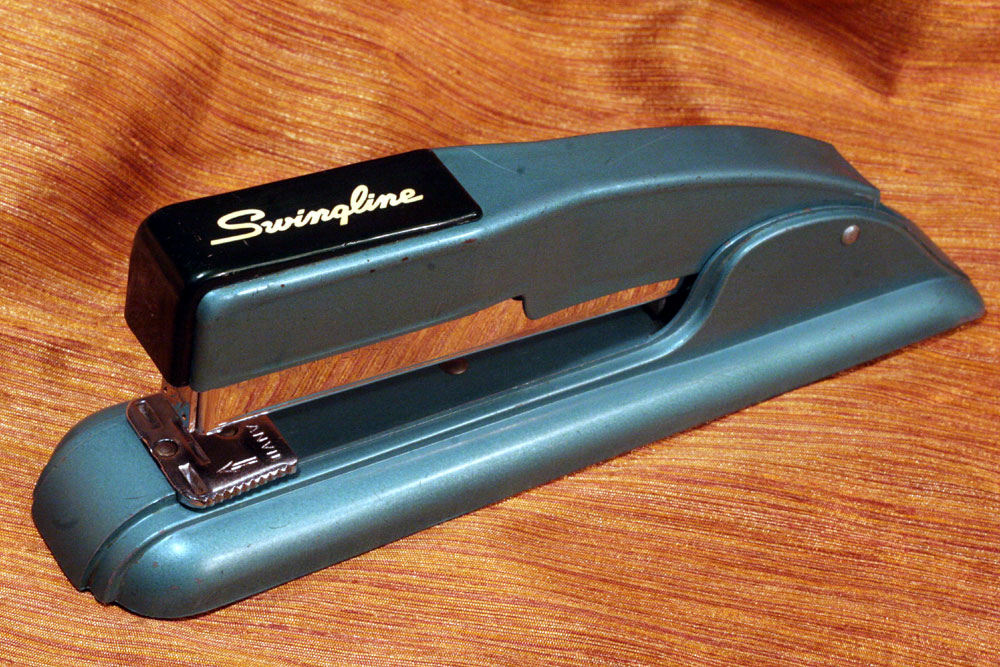
Howie discusses the "aerodynamic ribbed plastic hoods that looked like trains curving around a mountain...". While I don't see that as much as I see a common trend towards sweeping, rounding edges as seen in both. Especially noticable, at least in my opinion, is the shaping of the locomotive's nose along with the downwards curve in the front of the stapler, which are very similar.
In the late 1950s and 1960s, locomotive designs changed towards a boxier, more rugged design as passenger rail fell apart with the rise of the interstate highway system, and the appearance of a railroad's trains became less important as a selling point. For example, take a look at this GM SD40. The SD40 series was the most popular locomotive series of all time, with roughly 5,000 being built from the first one (pictured here) in 1964 to the last one in 1986.

Similarly, staplers evolved in the 1960s and 1970s towards a more squared design, illustrated by the Swingline 747. (It should be noted that the one pictured is a modern 747 model, though the design has changed minimally since its introduction in the 1970s.)

The rounded edges and rather plain color schemes represents a shift not only in locomotive and stapler design, but in industrial design in general, as there was a shift from smooth and round forms towards squarer ones. As Howie puts it, "the great era of squareness set in...the people at Bates and Swingline again were drawn along, ridding their devices of all softening curvatures and offering black rather than the interestingly textured tan".
Since the publishing of The Mezzanine, locomotive (and stapler design) haven't changed substantially, though locomotives have made a subtle movement since the 1990s to incorporate a bit less squareness to their designs, with designs such as the one pictured below, which incorporated angled edges moreso than curves, but moved away from the perpendicular style of diesel locomotives of the previous thirty years:

Staplers have also moved away from the square design slightly, and have actually reverted more towards their streamlined counterparts than locomotives have. Take into account the Swingliner 747 Rio Red (Office Space, anybody?). However, Swingline countinues to still offer their square 747's as well.

Stapler and locomotive design have evolved significantly over the past 50 years, and these changes have made significant differences in the appearance of them, as they are refined and improved upon over the years.
Subscribe to:
Comments (Atom)