Trains are pretty cool. Staplers are also pretty cool. And while you probably know me for my interest in trains, I've screwed around with staplers for a while too. Staplers can be pretty boring, but they're fun to mess with...and kinda dangerous! I've stapled my fingers numerous times while playing around with them, and one time (I don't know how) subbie year, I was screwing around with the magnetic bottom of my stapler and somehow made the magnet strong enough to literally rip the stapler apart and have all the metal pieces stuck to the bottom.
Cool stapler stories/mishaps aside, on pages 14-15 of The Mezzanine, our main character Howie refers to how "staplers have followed, lagging by about ten years, the broad stylistic changes we have witnessed in train locomotives...". This immediately caught my attention. Is there such a similarity between staplers and diesel locomotives? I set off to find that out. I'm going to start mid-twentieth century with the evolution of the stapler and the locomotive, as that's when my interest (and knowledge) in American railroading begins. Early diesel locomotives were streamlined models, such as the MLW FPA-4 pictured below:

Now we look at one of the most iconic staplers of the 1950s: Swingline's Model 27.
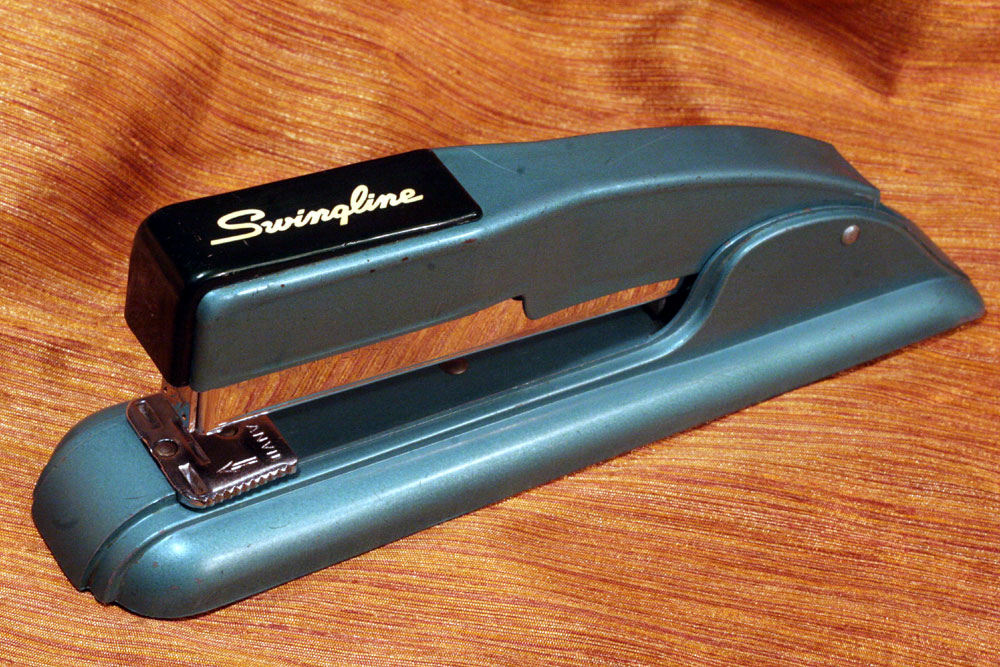
Howie discusses the "aerodynamic ribbed plastic hoods that looked like trains curving around a mountain...". While I don't see that as much as I see a common trend towards sweeping, rounding edges as seen in both. Especially noticable, at least in my opinion, is the shaping of the locomotive's nose along with the downwards curve in the front of the stapler, which are very similar.
In the late 1950s and 1960s, locomotive designs changed towards a boxier, more rugged design as passenger rail fell apart with the rise of the interstate highway system, and the appearance of a railroad's trains became less important as a selling point. For example, take a look at this GM SD40. The SD40 series was the most popular locomotive series of all time, with roughly 5,000 being built from the first one (pictured here) in 1964 to the last one in 1986.

Similarly, staplers evolved in the 1960s and 1970s towards a more squared design, illustrated by the Swingline 747. (It should be noted that the one pictured is a modern 747 model, though the design has changed minimally since its introduction in the 1970s.)
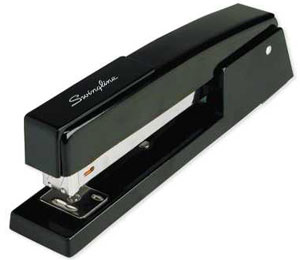
The rounded edges and rather plain color schemes represents a shift not only in locomotive and stapler design, but in industrial design in general, as there was a shift from smooth and round forms towards squarer ones. As Howie puts it, "the great era of squareness set in...the people at Bates and Swingline again were drawn along, ridding their devices of all softening curvatures and offering black rather than the interestingly textured tan".
Since the publishing of The Mezzanine, locomotive (and stapler design) haven't changed substantially, though locomotives have made a subtle movement since the 1990s to incorporate a bit less squareness to their designs, with designs such as the one pictured below, which incorporated angled edges moreso than curves, but moved away from the perpendicular style of diesel locomotives of the previous thirty years:

Staplers have also moved away from the square design slightly, and have actually reverted more towards their streamlined counterparts than locomotives have. Take into account the Swingliner 747 Rio Red (Office Space, anybody?). However, Swingline countinues to still offer their square 747's as well.

Stapler and locomotive design have evolved significantly over the past 50 years, and these changes have made significant differences in the appearance of them, as they are refined and improved upon over the years.

No comments:
Post a Comment